
Nikro Air Duct Cleaning in Far North Dallas: A Homeowner’s Guide
Most homeowners shopping for duct cleaning can’t tell one machine from another, so they compare on price and hope for the best. That’s the wrong yardstick. Nikro Industries builds equipment for industrial abatement and mold remediation work – it wasn’t designed for duct cleaning as an afterthought. When that same extraction power and HEPA filtration are applied to residential ductwork, the airflow and filtration specs land in a different category than the portable units most cleaners roll through the door. This guide explains what a Nikro-based job actually does inside your Far North Dallas home, in plain terms, so you can judge a bid on substance instead of a coupon. If you’d rather skip the homework and talk to someone, call (877) 792-7498.
What does negative-pressure duct cleaning actually mean?
Negative-pressure cleaning means the duct system is put under a slight vacuum before any debris is disturbed, so loosened dust travels toward the collection unit instead of drifting into your living room. The machine pulls air out of the system while a technician dislodges material inside it. Because the pressure inside the ducts is lower than the pressure in the room, air rushes inward at every opening, carrying dust with it. Without that pressure differential, agitation just floats debris into the air you breathe.
Here’s the sequence a Nikro system follows on a typical Far North Dallas job:
- Isolation. Supply and return registers are sealed off, and the collection unit is connected to the main trunk or plenum. The system is now a closed loop.
- Pressurization. The extraction unit pulls the whole duct run into negative pressure. No cleaning starts until that draw is established.
- Agitation. A rotary brush or air whip travels the interior, knocking debris loose. It moves toward the vacuum, not away from it.
- Collection. Debris and air pass through the machine’s filtration and end up in a sealed collection bag or bin.
- Exhaust. Filtered air leaves the unit. Nothing is vented back into your home unfiltered.
That word “filtered” is where the equipment class matters most. We’ve seen enough popular subdivision homes in Far North Dallas, where the same builder-grade flexible duct appears block after block and attic runs sit close to the air handler, to know how much loose material builds up in those runs over time. A machine that can’t hold pressure over the length of the system simply stirs it around. This is the core of air duct cleaning done properly: pressure first, then touch.
What do Nikro’s HEPA ratings mean in plain language?
HEPA filtration captures particles down to about 0.3 microns at very high efficiency, which includes the fine dust, mold spores, and pet dander that aggravate allergies. A shop-vac rated for sawdust is not in that class. When someone cleans ducts with a portable blower and a bag-style vacuum, the smallest particles – the ones that stay airborne longest and reach deepest into your lungs – often pass straight through the filter and back into the room.
Why does that matter specifically in Far North Dallas? Because the housing stock here asks a lot of an air system. Ceiling heights, second-floor attics that bake in July, and long flexible runs in tightly packed homes all mean dust has plenty of places to collect and plenty of chances to get redistributed. If anyone in your household deals with allergies or asthma, “we vacuumed it out” is not a satisfactory answer. You want to know what the machine captured and what it didn’t.
Nikro’s HEPA-rated units are built for remediation work, where the whole point is capturing contaminants rather than relocating them. That’s the difference between cleaning your ducts and moving your dust. For a home where air quality is the reason you’re calling at all, that distinction is the whole reason you called.
How does Nikro work alongside contact vacuuming and rotary tools?
Nikro extraction handles the “capture” half of the job. Contact vacuuming and rotary agitation tools like Rotobrush handle the “release” half. Neither works well alone. A powerful vacuum with nothing dislodging the debris just pulls from the surface of a dust mat. Agitation without extraction launches everything into the air.
In a well-run job, the two work in tandem:
- Rotobrush contact-vacuuming puts a rotating brush head directly against the duct interior, with the vacuum attached to the same head. Debris releases and gets pulled away in the same motion.
- Nikro negative pressure holds the entire system under vacuum, so anything the brush loosens still has somewhere to go even in runs the rotating head can’t reach.
- Abatement Technologies containment figures into the setup on jobs where air-quality conditions call for a higher level of control, keeping work areas isolated.
The result is a system where dislodgment and extraction happen together rather than in two separate, half-effective passes. We think of it as the difference between sweeping a floor and sweeping it while someone holds the dustpan directly under the broom. This combined approach is what separates a genuine HVAC cleaning from a surface wipe of the visible vents. It’s also why we carry Honeywell and Aprilaire filtration products: once the system is clean, upgrading filtration is often the next sensible step, and it’s good to install it in the same visit rather than leaving cleaned ducts to re-contaminate through a weak filter.
What does a Nikro-based cleaning job look like on-site?
A legitimate job is visible, methodical, and verifiable. If you hire duct cleaning in Far North Dallas and the technician is in and out in fifteen minutes with a hose and no setup, that’s not the process below. Here’s roughly what a professional Nikro-based visit involves:
- Assessment. The technician walks the system, locates the air handler, labels supply and return runs, and checks for leaks, disconnected joints, or damage that cleaning alone won’t fix.
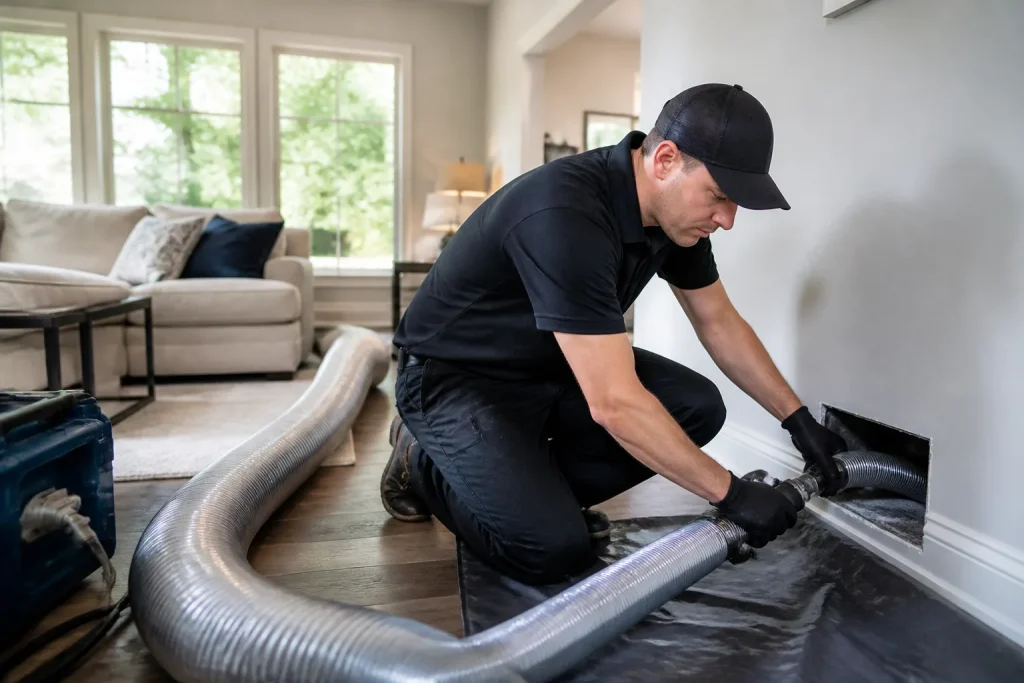
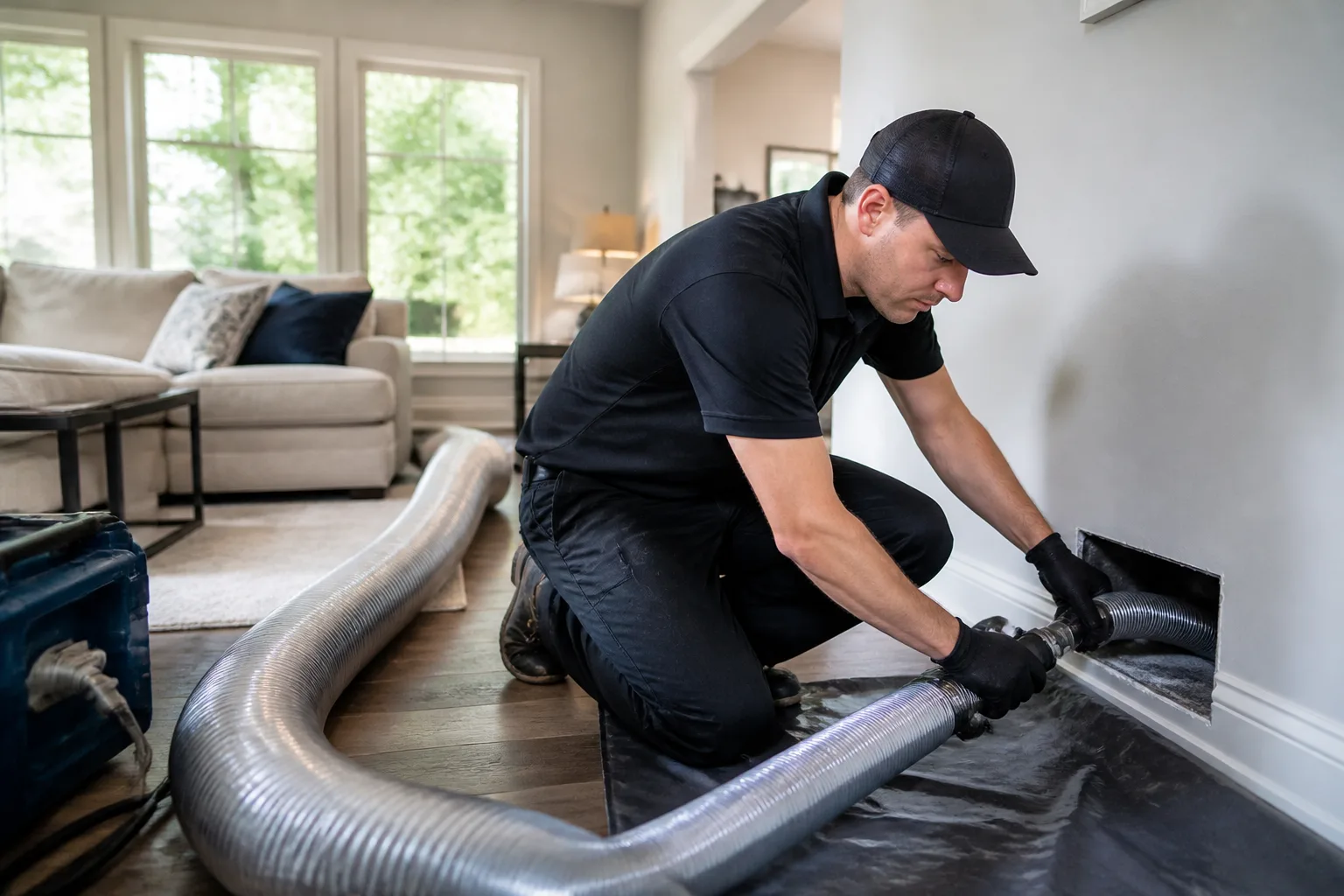
- Setup. Registers are removed and sealed. The collection unit is connected and energized. Pressure is confirmed before cleaning begins.
- Access. Where needed, small access points are created in the ductwork to reach sections a register can’t, then properly sealed afterward.
- Cleaning. Rotary agitation works through each run while the Nikro unit maintains extraction. Debris collects in the machine, not the room.
- Verification. The technician shows you what came out and checks the system for loose joints or leaks found during the work.
That last step matters. Duct repair and sealing happen in the same visit as the cleaning in a full-scope job. Cleaned ducts with an open seam in the attic will be dirty again soon enough. We repair what we find rather than cleaning around it.
Related services in Far North Dallas: if lint buildup in your dryer is part of your concern, dryer vent cleaning addresses a separate fire risk that many duct-only companies skip entirely.
Why does equipment class beat company size or marketing claims?
Equipment class tells you what a company can physically do inside your ducts. Company size and ad spend don’t. A large, well-marketed outfit with a portable unit will clean your ducts less thoroughly than a small outfit running Nikro and Rotobrush equipment. The machine determines the result.
When you’re comparing bids in Far North Dallas, ask these questions:
- “What machine will you use?” If they can’t name the equipment or describe its filtration, that tells you something.
- “Will you establish negative pressure before cleaning?” The answer should be immediate and specific.
- “What happens if you find leaks or damaged joints?” Repair and sealing should be part of the scope, not a referral to someone else.
- “Can you show me before-and-after photos of my own system?” Documented work is verifiable work.
The higher-end quote isn’t automatically better, but a suspiciously low quote on the same square footage almost always means cheaper equipment, less time, or both.
When to call a pro
If you’re seeing visible dust plumes at the registers, notice a musty smell when the air kicks on, or have dealt with recent renovation dust, a professional assessment makes sense. Our technicians have up to 13 years of experience, and the local pro we connect you with is licensed and insured as their state requires. You get one flat price per system agreed before work starts, and before-and-after photos of your own ducts.
The Bottom Line
Nikro equipment matters because it does a job most portable rigs can’t: it holds your duct system under negative pressure and captures fine particles through true HEPA filtration instead of blowing them into your living space. Paired with rotary agitation and contact vacuuming, it cleans, then lets you seal and upgrade. The tools used tell you more about a duct cleaning bid than any coupon or claim.
If you’re in Far North Dallas and need help, Air Duct Cleaning Far North Dallas offers free estimates – call (877) 792-7498. We answer 24/7, with fast dispatch from 7am to 7pm, Sunday through Friday. You’ll get a written estimate before any work starts, and cleaning covers the full air pathway from vent cover to air handler.
Frequently Asked Questions
Yes. Nikro builds machines for industrial abatement and mold remediation, so its units are engineered for high extraction power and true HEPA filtration. Many residential cleaners use consumer-grade shop vacs or light portable blowers that capture far less fine dust. The difference shows up most where it counts: whether small particles get trapped in the machine or recirculated into your rooms.
Pricing depends on your system’s size, number of runs, and whether repair or sealing is needed. We don’t quote per vent or tease a low coupon price that grows once a technician is on-site. Instead, you get one flat price per system, agreed before work starts, with a written estimate setting the final price. Call (877) 792-7498 for an exact quote – estimates are free.
A legitimate job is documented. Ask for before-and-after photos of your own ducts, watch the setup being established, and confirm the technician checks for leaks or disconnected joints before finishing. Cleaning without containment and verification is difficult to confirm after the fact. Call (877) 792-7498 to schedule a free estimate and see the process described in writing.
Most homes don’t need it on a fixed annual schedule. Visible dust at registers, musty odors when the system runs, recent renovation, or a household with allergy concerns are the practical triggers. HEPA-equipped cleaning also makes sense right after major work that stirs up dust. If you’re unsure whether your Far North Dallas home qualifies, call (877) 792-7498 for a free assessment.
Written by the team at Air Duct Cleaning Far North Dallas.
Need Air Duct Cleaning Help?
Call Air Duct Cleaning Far North Dallas - the local pro we connect you with is licensed and insured, with free written estimates in Far North Dallas.
(877) 792-7498